

Team Member Profile: Jamie McIntosh
.png)
At a Glance
Discipline: Technical Safety Engineering
Sector Focus: Upstream Oil & Gas
Engineering Roots: Piping & Mechanical Design and Engineering (15+ years)
Academic Study: BSc Mechanical Engineering, Masters in Safety and Reliability (in progress)
Chartered Status: Working towards Chartership
The Engineer Behind the Work
In technical safety, the most effective engineers are rarely those who stayed in one lane. At Katoni, Jamie McIntosh is a case inpoint. With a foundation forged across piping design, offshore surveys and multi-discipline project delivery, he brings a breadth of practical knowledge to technical safety that is difficult to teach from a textbook alone.
Based in Aberdeen and working predominantly on scopes in the North Sea, Jamie joined Katoni after more than a decade in front-end and detailed design. His transition into technical safety was a deliberate one and one that has shaped his approach to safety engineering ever since.
A Career Built From the Ground Up
Jamie's route into the oil and gas industry was anything but conventional. Growing up in Aberdeen during a prosperous time for the North Sea, he was drawn initially to the graphical, spatial nature of engineering design. After completing an HNC in Engineering Systems, followed by further study in mechanical engineering, he secured a trainee piping designer apprenticeship at Petrofac in 2010 - the start of a career that would span multiple operators, disciplines and project phases.
"Aberdeen was booming. That's where the work was - and I was ready to work."
Over the years that followed, Jamie progressed steadily from designer to senior designer to lead, eventually moving into piping engineering, working across the full project lifecycle: from concept and FEED through to detailed design and fabrication-ready documentation. A significant portion of that time was spent on North Sea assets, including extensive offshore survey work before digital twin technology became standard practice -giving him first-hand exposure to a broad range of platforms and installations.
That combination of design experience and offshore site knowledge is not something that can be replicated in a classroom. It informs the way Jamie now approaches technical safety: with an understanding of how assets are actually built, operated and maintained.
From Piping to Technical Safety: A Considered Move
Having delivered strong results on a major FEED scope at Petrofac, he was offered the opportunity to move into the technical safety team - initially on a part-time basis. However, he turned down the half-and-half arrangement.
"I said I'll commit to technical safety fully, ornot at all. I didn't want to end up with the worst of both worlds."
That all-or-nothing decision has proven well-founded. Now three years into his role as a technical safety engineer and 2 years at Katoni, Jamie is completing a Masters in Safety and Reliability alongside his professional responsibilities - a qualification he identified early as essential to ensuring he could do the job with true authority and to align with the requirements of chartership.
The masters, he says, has sharpened more than his theoretical knowledge. It has given him the academic grounding to argue a position with confidence, and to speak from a basis of regulatory and academic guidance rather than experience alone. In a discipline where the ability to influence design decisions can have serious consequences, that distinction matters.
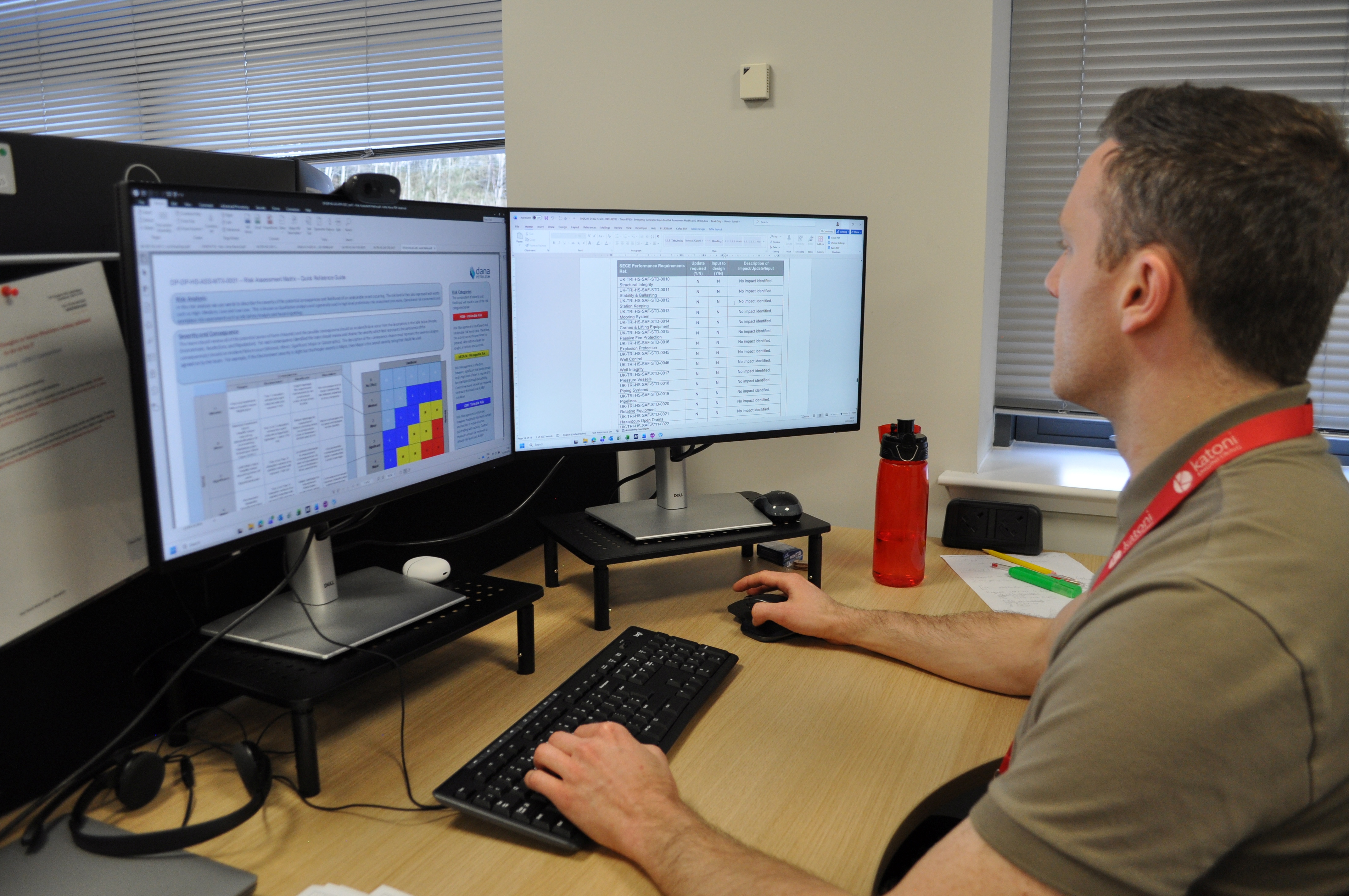
An Approach Built on Cross-Disciplinary Thinking
Ask Jamie where technical safety projects most commonly fall short, and his answer is unequivocal: communication. Specifically, the failure that comes from staying within a single discipline's boundaries whenthe job demands a broader view.
"Sometimes, technical safety engineers are encouraged to put blinkers on. But to genuinely influence design, you need a more holistic view."
His piping background gave Jamie a natural advantage here. He arrived in technical safety already fluent in the language of multiple disciplines – piping, structural, constructions, mechanical, electrical and instrumentation - and has actively built on that knowledge since. The result is a working style that prioritises early, proactive engagement with project team members: asking the questions other people haven't thought to ask, before those questions become expensive problems.
On a smaller project, Jamie's involvement may focus on a safety screening and targeted recommendations. On larger scopes, it extends to hazard identification and risk assessment studies (HAZIDs, HAZOPs and beyond), chairing workshops, and representing the technical safety function in client and cross-discipline meetings. In every case, the objective is the same: ensure the design is safe, compliant and fit for purpose.
What Good Looks Like
Jamie's standard for quality is a straightforward one: work that is ready to go without needing someone else to find the mistakes. He describes it as a "right first time" mentality - one that begins at the start of the process.
He references a principle instilled during his Petrofac years: the Rule of the Last Inch - the idea that the final details of any piece of work are the easiest to get wrong, and therefore demand the most attention. For Jamie, that translates into a discipline around front-loading effort: gathering the right information early, asking questions before they become actions, and verifying every detail before submission.
"It's not relying on someone else to catch a mistake. It's making sure there's nothing to catch."
Why Technical Safety Matters -and Why It's Worth Getting Right
Technical safety is sometimes viewed by clients as a regulatory obligation rather than a value-adding discipline. Jamie understands that perception and is measured in addressing it.
Along with ensuring the safety of personnel, the investment in rigorous technical safety work up front, he argues, almost always reduces cost over the full lifecycle of an asset. The CapEx-versus-OpEx trade-off is real, and the consequences of getting it wrong are not abstract. Incidents offshore are investigated thoroughly, and if technical safety was not taken seriously, the repercussions for the parties involved can be severe, both to personnel and financially. Even lower-level oversights, dismissed as minor at the time, have a tendency to compound.
For operators in the UK and Dutch North Sea working in a tightly regulated environment, that is not a risk worth taking. The value of an experienced technical safety engineer - one who understands the regulations, reads the design, asks the right questions of the right disciplines and delivers work that is ready to go - is concrete, measurable and significant.
Jamie McIntosh is a Technical Safety Engineer at Katoni, working across UK and Dutch North Sea projects. To discuss how our technical safety team can support your next scope, get in touch.
Speak to Our Team
Have a question or need support? Reach out and our team will get back to you promptly.
.png)
.png)
.png)
.png)
.png)
.png)
