

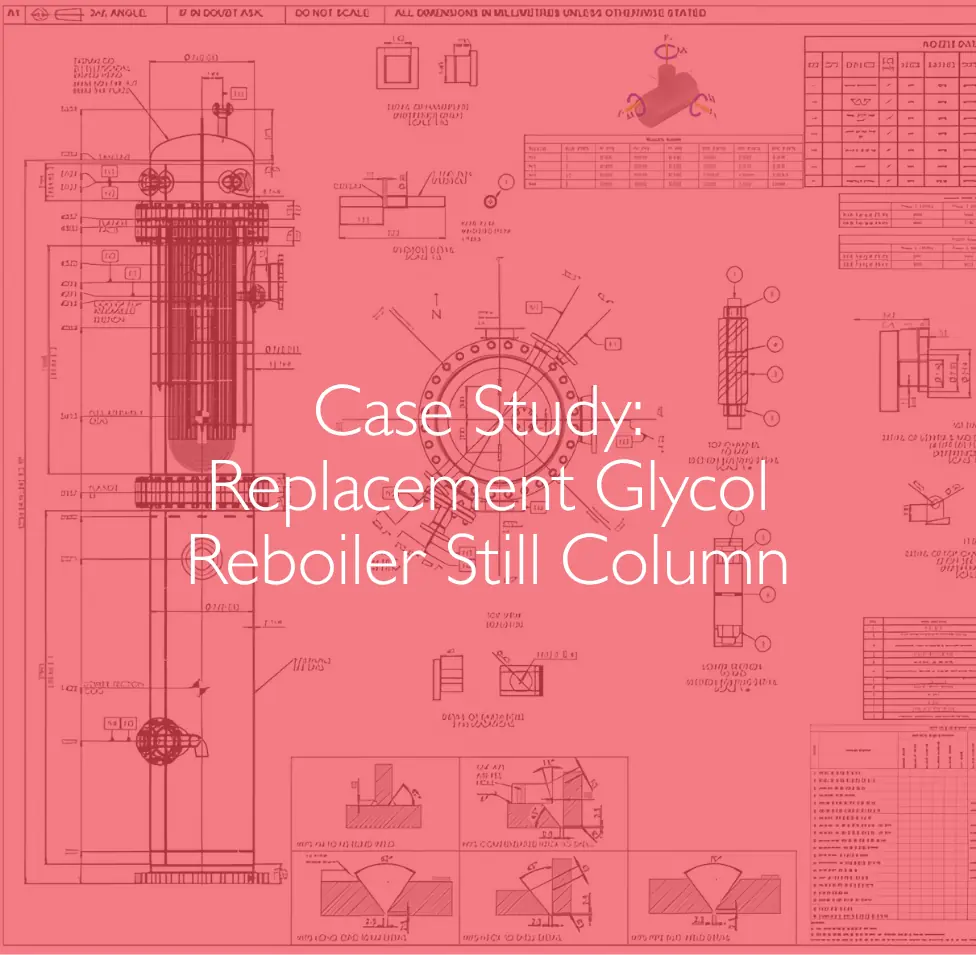
Case Study: Replacement Glycol Reboiler Still Column
The Challenge
Two corrosion failures on the same vessel removed any ambiguity. The next shutdown would either be planned, or forced.
Across ageing North Sea infrastructure, this situation is increasingly common. Equipment operating beyond its original design life, known degradation mechanisms already active, and shutdown windows that leave no room for error.
In this case, the client’s glycol reboiler still column had suffered repeated excessive wall thickness loss due to corrosion of the existing carbon steel vessel. Continued operation presented unacceptable risk. The requirement was clear: deliver a replacement that would not fail in the same way, and that could be installed without disruption to the wider system.
Engineering Approach
Material Selection
A structured assessment of material performance led to the selection of super duplex stainless steel. Its strength and corrosion resistance provided a step change in durability, addressing the root cause rather than replicating it.
Technical Specification & Compliance
The replacement vessel was defined against strict operational and design criteria, including capacity, pressure, and temperature requirements.
Compliance was embedded throughout, covering:
- PD5500 for pressure vessel design and construction
- ASME B16.5 for flange design
- API 660 and TEMA where relevant to thermal considerations
- ASTM material standards
Regulatory requirements were managed in full, including the Pressure Equipment (Safety) Regulations, PUWER, and LOLER.
.png)
Client Standards
A critical aspect of delivery was strict adherence to the client’s own engineering standards and specifications. These imposed requirements went beyond baseline industry codes and demanded a higher level of rigour across design, fabrication, inspection, and documentation.
Meeting these standards required detailed coordination, robust quality control, and consistent engineering discipline throughout the project lifecycle.
Brownfield Constraints
The defining challenge was integration into an existing offshore system.
The replacement still column had to align exactly with all existing piping connections. The shutdown window was fixed and limited, leaving no opportunity for on-site adjustment. The use of closing spools was not viable.
This required:
- Accurate dimensional capture of the existing installation
- Tight control of fabrication tolerances
- Detailed verification of all nozzle locations and orientations
There was no margin for misalignment. The vessel had to fit first time.
Delivery
The vessel was engineered, fabricated, and installed within a constrained annual shutdown.
Execution outcomes:
- All connections aligned within allowable tolerances
- Installation completed without modification to existing pipework
- No requirement for closing spools
- Shutdown completed without overrun
-
The installation proceeded exactly as planned, with no corrective work required offshore.
Outcome
The project delivered both immediate assurance and long-term operational value:
- Removal of a known and repeated corrosion failure mechanism
- Increased reliability through upgraded material selection
- Extended service life of the asset
- Reduced inspection and maintenance burden
- Lower risk profile for future shutdowns
Why It Worked
Brownfield delivery depends on precision and ownership of detail. This project required both.
Success came from understanding the constraints, engineering to meet them exactly, and maintaining control from specification through to installation.
Strict compliance with demanding client standards ensured quality was not just achieved, but demonstrated at every stage.
An independent structure enabled decisions to be made without delay. When timelines tightened, the response adjusted immediately to protect delivery.
Summary
A critical vessel with a history of failure was replaced with a robust, engineered solution designed for long-term performance and seamless integration.
Delivered to exacting standards. Installed without modification. Completed without compromise.
Speak to Our Team
Have a question or need support? Reach out and our team will get back to you promptly.
.png)
.png)
.png)
.png)
.png)

.png)